Backgrounder published on CFR.org. August 2020.
India is home to some two hundred million Muslims, one of the world’s largest Muslim populations but a minority in the predominately Hindu country. Since India’s independence, Muslims have faced systematic discrimination, prejudice, and violence, despite constitutional protections.
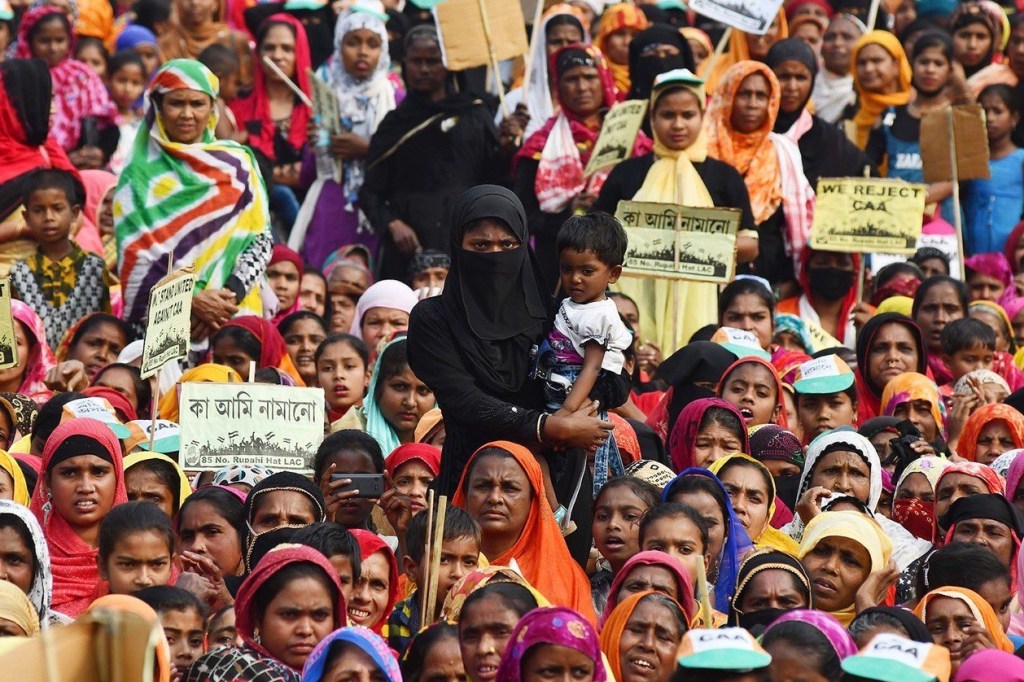
Experts say anti-Muslim sentiments have heightened under the leadership of Prime Minister Narendra Modi and the ruling Bharatiya Janata Party (BJP), which has pursued a Hindu nationalist agenda since elected to power in 2014. Since Modi’s reelection in 2019, the government has pushed controversial policies that critics say explicitly ignore Muslims’ rights and are effectively intended to disenfranchise millions of Muslims. The moves have sparked protests in India and drawn international condemnation.
How many Muslims live in India?
India is a country of religious, ethnic, and linguistic diversity. Its estimated two hundred million Muslims, most of whom identify as Sunni, account for about 15 percent of the population, by far the largest minority group. Hindus make up about 80 percent. The country’s Muslim communities are diverse, with differences in language, caste, ethnicity, and access to political and economic power.
How did India’s partition influence Hindu-Muslim relations?
Some of the animus between India’s Hindus and Muslims can be traced back to the cataclysmic partition of British India in 1947, scholars say. Economically devastated after World War II, the British lacked the resources to maintain their empire and moved to leave the subcontinent. In the years before partition, the Indian National Congress party, under the leadership of Mahatma Gandhi and Jawaharlal Nehru, pushed for independence, organizing civil disobedience and mass protests against British rule. Meanwhile, the All-India Muslim League political group, led by Muhammad Ali Jinnah, called for a separate state for Muslims.
In 1947, a British judge hastily decided the borders for a Hindu-majority India and a Muslim-majority Pakistan (including what is today Bangladesh). The partition sparked deadly riots, gruesome communal violence, and mass migrations of Muslims to Pakistan and Hindus and Sikhs to India. Survivors recall blood-soaked trains carrying refugees from one country to the other, towns burned to the ground, and bodies thrown in the streets. Historians estimate between two hundred thousand and two million people were killed.
Why communities that had coexisted for hundreds of years attacked each other remains unclear. Some experts fault the British and their “divide-and-rule” strategy, which provided some electoral privileges for the Muslim minority, about 25 percent of the population. Others point to tensions between Hindu and Muslim political movements, which rallied constituents along religious lines.
Around thirty-five million Muslims stayed in India after partition, choosing to remain with relatives and preserve their property and wealth, among other reasons. Many opposed the creation of a separate state for Muslims in the first place.
 Lindsay Maizland
Leave a comment