Published on CFR.org and frequently updated.
China pledged to preserve much of what makes Hong Kong unique when the former British colony was handed over more than two decades ago. Beijing said it would give Hong Kong fifty years to keep its capitalist system and enjoy many freedoms not found in mainland Chinese cities.
But it seems that these promises are fading. In recent years, Beijing has taken what critics say are brazen steps to encroach on Hong Kong’s political system and crack down on dissent. These moves sparked massive protests in Hong Kong and have drawn international condemnation. In 2020, Beijing passed a controversial national security law and arrested dozens of pro-democracy activists and lawmakers, dimming hopes that Hong Kong will ever become a full-fledged democracy.
Is Hong Kong part of China?
Hong Kong is a special administrative region of the People’s Republic of China that has been largely free to manage its own affairs based on “one country, two systems,” a national unification policy developed by Chinese leader Deng Xiaoping in the 1980s. The concept was intended to help integrate Taiwan, Hong Kong, and Macau with sovereign China while preserving their unique political and economic systems. After more than a century and a half of colonial rule, the British government returned Hong Kong in 1997. (Qing Dynasty leaders ceded Hong Kong Island to the British Crown in 1842 after China’s defeat in the First Opium War.) Portugal returned Macau in 1999, and Taiwan remains independent.
The Sino-British Joint Declaration of 1984 dictated the terms under which Hong Kong was returned to China. The declaration and Hong Kong’s Basic Law, the city’s constitutional document, enshrine the city’s “capitalist system and way of life” and grant it “a high degree of autonomy,” including executive, legislative, and independent judicial powers for fifty years (until 2047).
Chinese Communist Party officials do not preside over Hong Kong as they do over mainland provinces and municipalities, but Beijing still exerts considerable influence through loyalists who dominate the region’s political sphere. Beijing also maintains the authority to interpret Hong Kong’s Basic Law, a power that it had rarely used until recently. All changes to political processes have to be approved by the Hong Kong government and China’s top legislative body, the National People’s Congress, or its Standing Committee.
Hong Kong is allowed to forge external relations in certain areas—including trade, communications, tourism, and culture—but Beijing maintains control over the region’s diplomacy and defense. Under the Basic Law, Hong Kongers are guaranteed freedoms of the press, expression, assembly, and religion, as well as protections under international law. But in practice, Beijing has curtailed some of these rights.
Is Hong Kong a democracy?
Although Hong Kong has certain freedoms, it is not a full democracy [PDF] by international standards. China is a one-party state and is reluctant to allow Hong Kong to hold free and fair elections. Experts say that ambiguity in the Basic Law heightens this fundamental tension. The document states that the “ultimate aim” is to have Hong Kong’s leader elected by a popular vote, but it does not give a deadline for this to occur.
Since the handover, there have been no free votes by universal suffrage for the chief executive, who is the head of the Hong Kong government. Instead, an election committee composed of representatives from Hong Kong’s main professional sectors [PDF] and business elite has selected them. During the most recent election, in 2017, only candidates vetted by a nominating committee chosen by Beijing were allowed to run. Carrie Lam, viewed as an establishment candidate, won and became Hong Kong’s first woman chief executive.
Thirty-five members of Hong Kong’s legislature, the Legislative Council, are elected by direct voting, while the other thirty-five members are chosen by groups representing different industries and professions. Hong Kong residents also get to vote for members of their local district councils, which handle day-to-day community concerns.
Unlike China, Hong Kong has numerous political parties. They have traditionally split between two factions: pan-democrats, who call for incremental democratic reforms, and pro-establishment groups, who are by and large pro-business supporters of Beijing. The latter have typically been more dominant in Hong Kong politics, but pro-democracy groups have increasingly garnered more support from voters.
Traditionally, only a small minority of Hong Kongers have favored outright independence. However, in recent years, student protesters demanding a more demoractic system have formed political groups, including more radical, anti-Beijing parties, such as Youngspiration, and Hong Kong Indigenous, and Demosisto. These parties tapped into the phenomenon in which more and more people see themselves as Hong Kongers or as Hong Kongers in China as opposed to identifying as Chinese nationals. Several of these groups disbanded in 2020, however, as Beijing cracked down on political opposition.
How has Beijing eroded Hong Kong’s freedoms?
Beijing has been chipping away at Hong Kong’s freedoms since the handover, experts say. Over the years, its attempts to impose more control over the city have sparked mass protests, which have in turn led the Chinese government to crack down further.
“In the fifteen years after the handover, there was a series of official initiatives aimed at enhancing Beijing’s control in ways that would undermine both the autonomy and the rule of law,” Michael C. Davis writes in his book Making Hong Kong China.
For instance, in 2003, the Hong Kong government proposed national security legislation that would have prohibited treason, secession, sedition, and subversion against the Chinese government. In 2012, it tried to amend Hong Kong schools’ curricula to foster Chinese national identity, which many residents saw as Chinese propaganda. And in 2014, Beijing proposed a framework for universal suffrage, allowing Hong Kongers to vote for the city’s chief executive but only from a Beijing-approved short list of candidates. Protesters organized massive rallies, known as the Umbrella Movement, to call for true democracy.
In the years following the 2014 protests, Beijing and the Hong Kong government stepped up efforts to rein in dissent, including by prosecuting protest leaders, expelling several new legislators, and increasing media censorship.
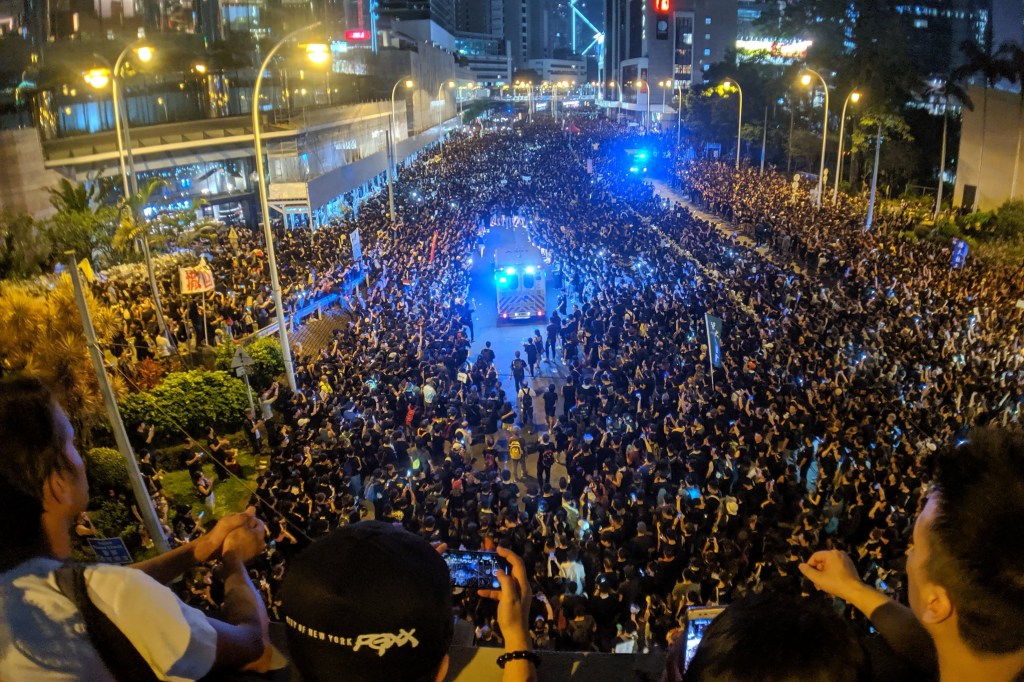
In the summer of 2019, Hong Kong saw its largest protests ever. For months, people demonstrated against a Beijing-endorsed legislative proposal that would have allowed extraditions to mainland China. Many protesters believed Beijing had eroded Hong Kong’s freedoms to such an extent that they thought, “either we stop it now, or it’s just basically going to be hell,” says Victoria Tin-bor Hui, a political science professor at the University of Notre Dame. Reports of police brutality, including the excessive use of tear gas and rubber bullets, exacerbated tensions. Chief Executive Lam withdrew the bill in September, but the protests, which garnered international attention, continued until the outbreak of COVID-19 in early 2020.
 Lindsay Maizland
Leave a comment